
How Indie Devs Are Making Money From Vibe-Coded Games in 2026
Yes, indie developers are making money from vibe-coded games in 2026, not life-changing money so far, but real money. The patterns that work look very different from traditional indie game monetisation. This article breaks down the five revenue models that have actually paid off for solo vibe coders, the numbers behind each, and the strategy mistakes that consistently kill earnings.
The honest framing up front: the median vibe-coded game makes nothing. The top ~5% of listings on our leaderboard generate meaningful revenue. The strategies below are what separate those tiers.
If you haven't shipped a game yet, start with How to Vibe Code a Game in a Weekend. If you're picking tools, see Best AI Game-Building Tools in 2026.
The 2026 revenue landscape, honestly
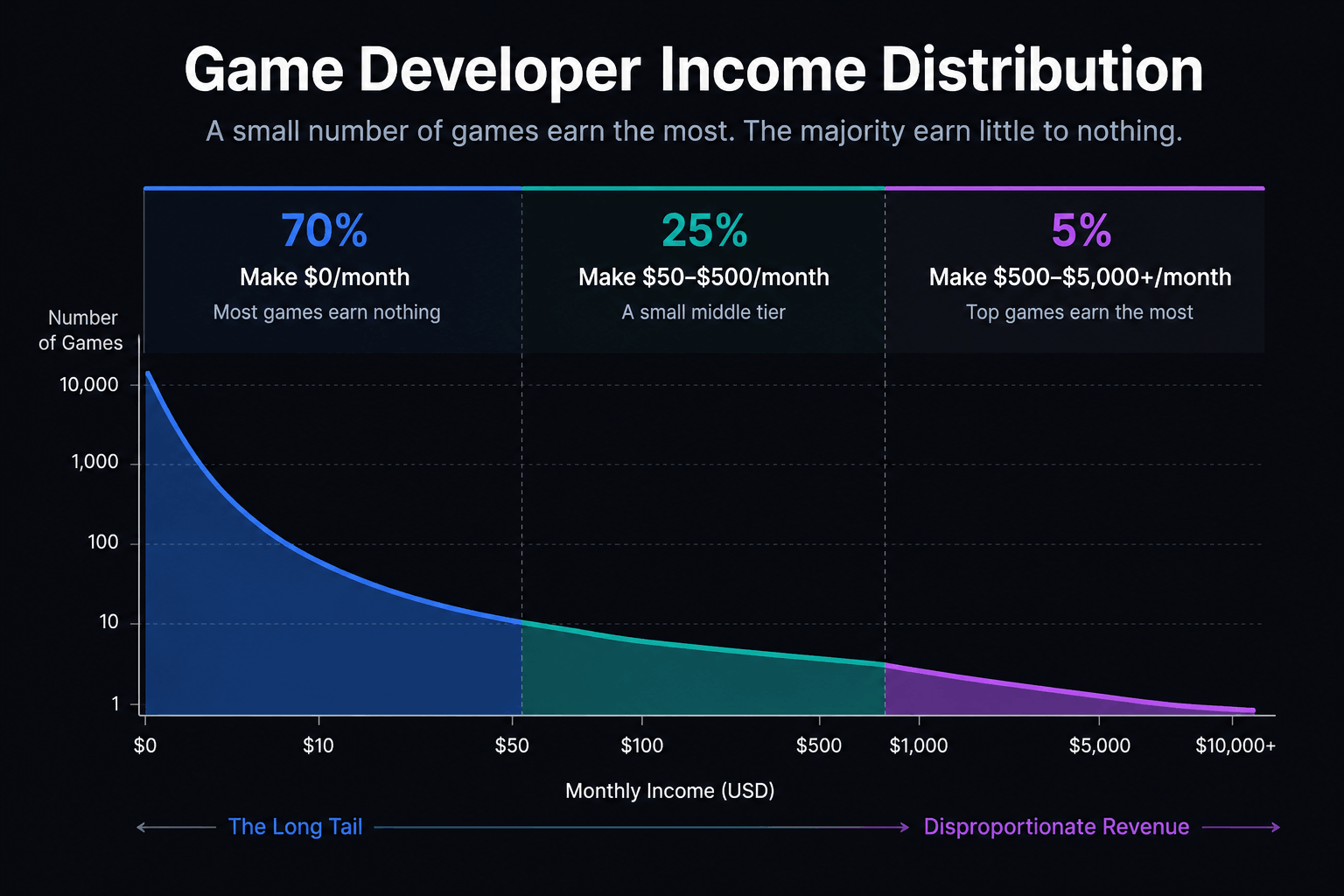
Let's set expectations. Three observed numbers from the vibe-coded indie scene this year:
- Median earnings of a listed vibe-coded game: $0/month. Most games never generate revenue.
- Top quartile (a leaderboard top-100 listing with active votes): $20-$2000/month, mostly from banner ads.
- Top 1% (a viral hit or a creator with a portfolio of 5+ active games): $1,000-$100,000/month. With outliers that generate life-changing money.
The realistic ambition for most readers is to be in the top quartile. The top 1% is achievable, but it requires consistently applying the strategies in this article across multiple games.
The five revenue models that actually work
1. Banner ads on free games
How it works: Your free browser game embeds a banner slot. You sell the slot to advertisers (directly, via a network, or by listing it on a marketplace like our /advertise page).
Realistic revenue: $1-5 RPM (revenue per thousand sessions) for direct sales, sometimes higher in vertical-fit niches. A game with 50,000 monthly sessions can clear $100-300/month from banners alone.
Why it works for vibe coding: Vibe-coded games tend to be free, browser-playable, and short-session, which is exactly the inventory format banner advertisers want. No app-store cut, no subscription friction, no payment integration headaches.
The trick: Place the banner above the play area, not over it. A respected banner above the game beats an aggressive interstitial every time | the bounce rate from interstitials destroys your session count, which destroys your inventory value.
2. Voluntary donations + Patreon
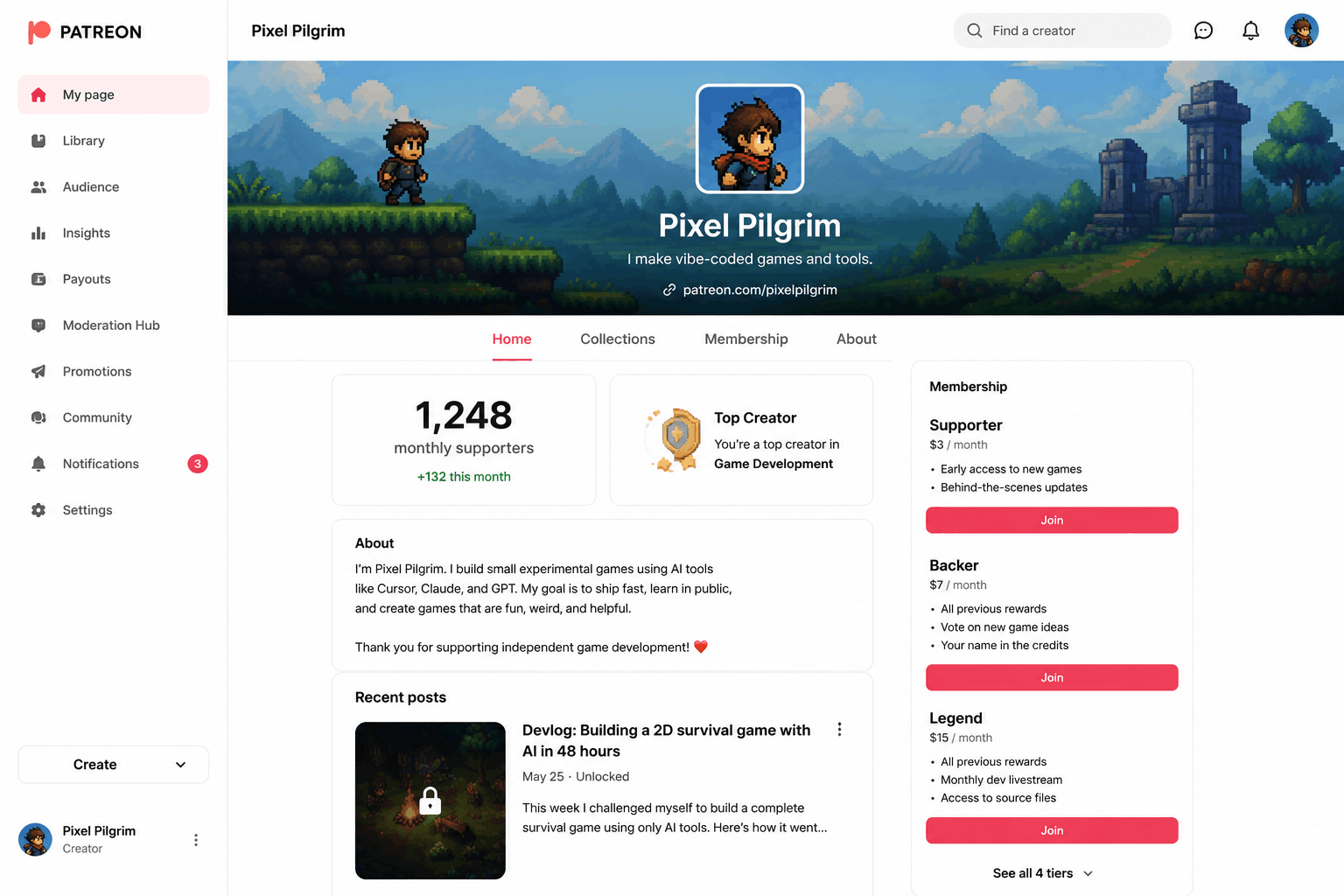
How it works: A "support the dev" button on the game's loading screen, end screen, and listing. Backed by Patreon, Buy Me a Coffee, or Ko-fi. Optional perks for supporters (cosmetic unlocks, early access, voting on next features).
Realistic revenue: 0.5-2% conversion of monthly active players to paying supporters at $3-7/month. A game with 10,000 monthly active players might net 50-200 supporters at $5/month, so roughly $250-1,000/month at the high end.
Why it works for vibe coding: Vibe coders often have a personal-creator vibe (Twitter / X presence, built-in public posts) that translates well to patron support. Players who liked the built-in-public process will pay to keep the developer building.
The trick: Tie supporter perks to ongoing production, not one-time rewards. "Vote on next month's mini-game" beats "get a hat" for retention.
3. Cosmetic / paid item sales
How it works: Free game with optional paid cosmetics (skins, particle effects, custom names, profile flair). Revenue collected via Stripe Checkout or a similar one-click flow.
Realistic revenue: Highly variable. The 1-2% of games that nail cosmetics can earn $500-5,000/month from a single title. The 80% that try this earn under $20/month.
Why it works for vibe coding: Multiplayer games specifically have strong cosmetic-monetisation dynamics | cosmetic prestige is a real social signal in lobbies. A game on our multiplayer leaderboard with 5 distinct cosmetic tiers can convert 1-3% of regulars into payers.
The trick: Cosmetics need to be visible to other players. Single-player cosmetics rarely convert. If your game is single-player and you want cosmetic monetisation, find a way to make the cosmetic visible | a leaderboard avatar, a public profile, a shareable replay clip.
4. Promoted listings + sponsorships on VibeTopList
How it works: The reverse of model 1 | you are the buyer. Your game pays to be promoted on a directory, leaderboard, or community newsletter. The math works when the cost-per-vote is lower than your eventual lifetime ad revenue per player.
VibeTopList offers a Gold tier and banner placements specifically for this | see our Gold tiers and advertise page. The Gold tier adds a vote bonus + visual decoration; banner placements give you 728x90, 300x250, or 300x600 inventory across the site.
Realistic ROI: Hard to predict | it depends entirely on your game's monetisation downstream. Don't buy ads for a free game with no banner monetisation; the math won't work.
The trick: Buy promotion only for games that are already converting players to revenue. Promotion amplifies; it doesn't create.
5. Funnel to a paid product
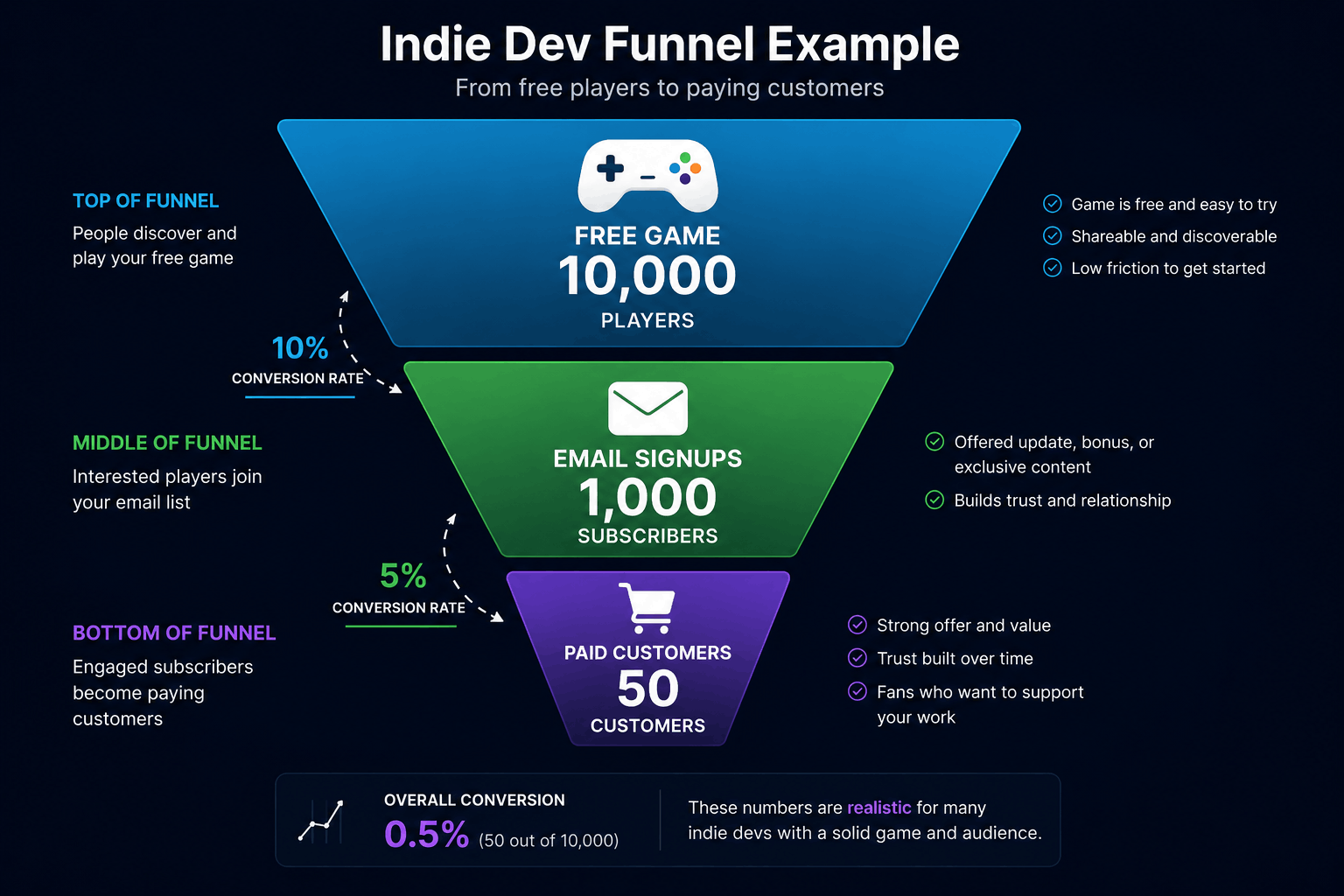
How it works: The free game is a top-of-funnel content marketing asset for a paid SaaS, course, agency, or other product you sell. The game itself doesn't have to be monetised | it's the lead-gen.
Realistic revenue: Highest ceiling of all five models, but only works if you have a paid product the game audience would buy. A "vibe-coded business simulation" funneling to a paid productivity-tool subscription can convert 0.1-0.5% of players to paying customers, which at $20+/month subscription can easily hit five figures monthly.
Why it works for vibe coding: The audience is technical-curious, indie-friendly, and pre-disposed to try new tools. Strong overlap with productivity, dev-tools, and creator-economy buyer personas.
The trick: The game has to be real, fun, and standalone. If players sense the game is just bait, they bounce. The game needs to genuinely delight to do its content-marketing job.
The portfolio strategy
The single highest-leverage decision a vibe coder can make in 2026 is to build a portfolio of small games rather than one big one.
The math: if any single game has a 5% chance of becoming a hit, building five games gets you to a 23% chance of having a hit. Building ten gets you to 40%. The portfolio is the strategy. Every successful vibe coder we know runs 5-15 games at a time.
Three implications:
- Set a hard time budget per game. 30 hours, 50 hours, whatever. When you hit it, ship and start the next one.
- Cross-link games. Every game's "thanks for playing" screen should link to your other games. Players who liked one will try another. Free traffic across the portfolio.
- Maintain only the top performers. If a game isn't in your top 3 by revenue or retention after 60 days, freeze it. Don't iterate. Move on.
Distribution: where to actually get players
Five channels that work in 2026, in order of ROI for vibe-coded games:
1. VibeTopList leaderboard
Designed for exactly this. Free listing, monthly reset, callback API for incentivised voting. Most cost-effective channel for genre-fit games. Add yours.
2. X / Twitter build-in-public
Post 3-5 build clips per week with #vibecoding and #vibejam. The audience is small but high-converting. Threads about your build process compound | one good thread can drive 10,000 sessions over a year.
3. Reddit (selectively)
r/IndieGames, r/WebGames, r/incremental_games, the genre-specific subs. Don't spam | one good post per game, with real engagement, beats five drive-by promos.
4. The Vibe Jam
The annual jam is a rocket boost for visibility. See our Vibe Jam 2026 guide. Even a top-50 finish drives weeks of organic traffic.
5. Influencer/streamer outreach
Targeted, not shotgun. Find streamers who play browser indies or .io games, send them a direct, specific message ("here's a 60-second multiplayer game tuned for your stream's chaos energy"). One pickup can move thousands of monthly sessions.
Tax and legal essentials
Three things that most solo vibe coders miss until it's painful.
Register a sole-proprietor or LLC
Even small revenue benefits from being run through a legal entity. The cost is low; the simplicity of taxes and the liability buffer are real.
Keep AI-asset licences clean
If you use AI-generated music (Suno, Udio) or art (Midjourney, Flux) commercially, you need the commercial-tier subscription at the time of generation. Retroactive upgrading does not always cover earlier work. Check the current terms of each tool annually.
Disclose AI use where required
Some platforms (Steam, Apple App Store) require explicit disclosure of AI-generated content. The web is unregulated for now, but if you ship to any platform, read their current policy before submitting.
Common monetisation mistakes
- Charging upfront for a vibe-coded game. The audience expects free. Paid vibe-coded games that aren't a clear premium tier almost always underperform versus the same game with a freemium model.
- Aggressive ads. Interstitial-on-load destroys your retention. Use one banner above the game, then earn the right to a second placement after sustained traffic.
- Ignoring mobile. Mobile is 50%+ of browser game traffic. If your game can't run on mid-range phones, you've capped your monetisation by half.
- Building one big game. The portfolio strategy is more effective than the single-bet strategy. See above.
- Skipping the callback API. Incentivised voting drives both votes (visibility) and retention (return visits). Free to add. /api-docs.
[Image suggestion: A "monetisation mistakes" infographic | 5 don'ts with crossed-out icons and 5 do's with green checks.]
FAQ
How much money can I realistically make from a vibe-coded game?
The median is zero. The top quartile of listed games on our leaderboard generates $20-$2000/month, mostly from microtransactions and donations. The top 1% (viral hits or 5+ game portfolios) generate $1,000-$100,000+/month. Plan for the median; play for the upside.
What's the best monetisation model for a free browser game?
Banner ads + voluntary donations are the easiest and most reliable combination. Cosmetic sales are higher upside but only work for multiplayer or social games. Funnelling to a paid product has the highest ceiling but requires you to also have that paid product.
Can I sell a vibe-coded game directly to players?
Yes, but the conversion rate is low. The audience expects free browser games. If you go paid, position it as a premium tier on top of a free version, not a wall in front of a regular game.
Do I need to disclose AI use to my players?
Legally, no, on the open web. Reputationally, yes | the audience values transparency. A simple "built with [tool] in [time]" line in the listing earns goodwill.
How do I find advertisers for my game?
Three options: list a banner slot on a marketplace like /advertise on VibeTopList, join an indie-game ad network, or sell directly to relevant SaaS companies (game-dev tool companies are an obvious fit).
Should I make one big game or many small ones?
Many small ones, almost always. The portfolio strategy is what separates top-1% earners from one-hit wonders. Set a 30-50 hour cap per game and ship many.
Is the vibe-coded game market saturated?
The market for new players is much larger than the supply of quality games. The market for hosting another generic platformer is saturated. Specific weird, unique games still cut through.
What's the easiest first revenue dollar to earn?
A "Buy me a coffee" button on a free game with 5,000+ monthly active players. Real, low-friction, and the first dollar is the hardest one psychologically | get past it.
Bottom line
Vibe-coded game monetisation rewards portfolio thinking, light-touch monetisation, and audience-genuine creator behaviour. Build a few small games, listing each free at VibeTopList, layer banner ads + voluntary donations as your starting stack, and study which titles convert. The top-quartile income is real and reachable. The top-1% income exists, too | just don't build your plan around it.
Built a vibe-coded game?
List it free on VibeTopList | pick up a permanent backlink, organic SEO traffic, and engaged players who actually vote.
+ Submit Your Game