
How to Get People to Play Your Vibe-Coded Game
What we see on VibeTopList
Since October 19, 2026 we count what visitors do on every game's page: who opens it, and who presses Play. Each person counts once per game per day. Bots, admins and the game's own maker are left out. This is what the first weeks show.
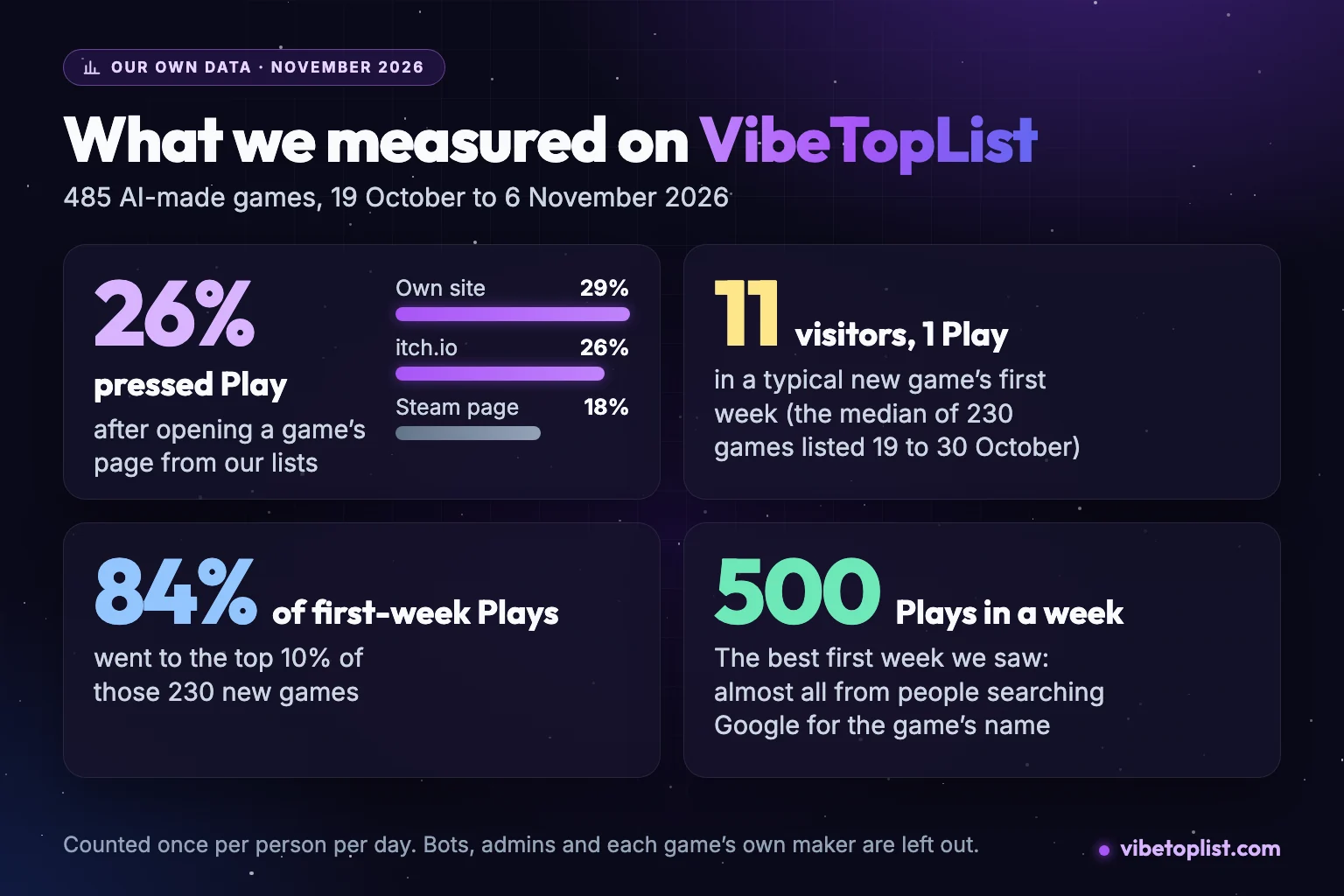
- About 1 in 4 people press Play. Of the people who opened a game's page from one of our lists, 26% pressed Play (67 games with at least 30 such visitors, October 19 to November 6).
- A playable link beats a store page. When Play opened the game itself, on its own site or on itch.io, 26 to 29% pressed it. When it opened a Steam page, 18% did. That is only four games, so take it as a hint. It matches a survey of 169 itch.io developers by Chris Zukowski, though: 37% of viewers played a browser game, against 6% for download-only games (How To Market A Game).
- Polish didn't move that number. Games with a trailer, more screenshots or a longer description didn't get a clearly higher share of visitors to press Play. What differed between games was how many people opened the page at all.
- Most new games start quietly. Of the 230 games listed between October 19 and 30, half had 11 visitors or fewer in their first week, and half had one Play or none. The top 10% got 84% of all first-week Plays.
- The breakouts brought their own crowd. The best first week we measured, 500 Plays, came almost entirely from people who searched Google for the game's name. They had heard of it somewhere else first.
So a listing is a start, not a launch. The rest of this guide is about the "somewhere else".
Make your game playable from one link
Every extra step between a curious person and your game loses some of them. Check these before you share anything:
- It runs in the browser. A download asks for more trust than a click. If your game is a desktop build, a short browser demo is worth making.
- No sign-up before the first game. itch.io asks makers to "avoid putting third-party login walls in front of your game unless necessary" (itch.io quality guidelines), and Hacker News asks that a Show HN be easy to try, "ideally without barriers such as signups or emails" (Show HN guidelines). Let people play first and offer an account to save their progress later.
- It works on a phone, or says clearly that it needs a keyboard. A third of the people who reach VibeTopList from Reddit are on a phone, and so are 37% of those who come from Google (October 8 to November 6, 2026).
- It loads fast. CrazyGames says its top games "load in under 10 seconds, and have a build size below 20 MB" (CrazyGames). Poki asks for an initial download of no more than 5 MB (Poki).
- The first ten seconds are play. Skip the long intro and teach the controls while the player is already moving.
Views but no plays? Check three things in this order: is there a big Play button on the first screen, does the game load on a phone, and does the page show real gameplay (a GIF or clip) before the text?
Prepare a launch kit
Make these once and reuse them everywhere you post:
- A name people can search for. itch.io warns that a title that is "a single letter or a single common English word may limit your project's discoverability in search" (itch.io). Google works the same way: a name nobody else uses is a name you can be found by.
- A one-line pitch that says what you do in the game. "A tower defence game where you build the maze" beats "an epic strategy adventure".
- A cover image that shows the game, not only its logo. On itch.io the cover is 315 by 250 pixels or larger in the same shape, such as 630 by 500.
- A 15 to 30 second clip that opens on gameplay, plus three or more screenshots.
- A short description: what it is, how to play, the controls, what's new, and one line on how you used AI.
- One home for the game: your own site or its itch.io page. Share that link everywhere, so every post sends people to the same place.
The kit's job is to earn the click. On VibeTopList a trailer didn't change how many visitors pressed Play, but a good clip is what makes someone stop scrolling in a feed, a portal or a subreddit.
Where to publish your game for free
Put the game where people already go looking for something to play. All of these are free to join. The ones that pay you have stricter rules.
itch.io
- The default home for small games. Upload a zip with an index.html and itch.io runs it right on your page.
- Don't count on "Most Recent". itch.io says it plainly: "Recently released is a very bad place to launch your project!" What helps instead, in its words: "Getting real people to visit your page and interact with it can help your page rise up on our browse pages" (itch.io). Bring your own visitors.
- Post devlogs. "Devlog posts are distributed to our users through email digests", and announcing a big update "may contribute to how your page is ranked" (itch.io).
- Announce it once on the community's Release Announcements board, which itch.io calls "our designated place for creators to announce and show off their own work" (itch.io quality guidelines).
- Fill in the AI disclosure (more on that below), and pick tags players browse. Some AI game lists find new games through tags: the itch.io tags vibe-coding, made-with-ai and vibejam.
One limit: browser games on itch.io can only take donations. To charge for a game there, it has to be a download.
Web game portals: CrazyGames, Poki, Kongregate and Y8
Portals have millions of players and pay a share of the ad revenue, but they review every game.
- CrazyGames starts every game with a Basic Launch: "a limited audience for a temporary period of 7 to 21 days", with no CrazyGames code needed in your game. It ends once your game "has been live for at least 7 days and has reached at least 500 plays" (CrazyGames docs). It is the quickest way to test a game on real players. Its benchmarks: successful games often see "10+ minutes of average play time" and strong ones reach "10-15% Day 1 Retention" (CrazyGames).
- Poki is curated: "Every game on Poki is hand-picked." New games go through playtests and a fit test with 500 players, where a healthy result is "3+ minutes average playtime, with 25%+ of plays over 3 minutes" (Poki). Its deals are exclusive on the web by default, for five years, and that includes Discord and YouTube Playables (Poki). Poki also blocks external requests and in-app purchases.
- Kongregate reopened to new games in 2026. Games approved after April 6, 2026 get a time-limited 70% revenue share (Kongregate).
- Y8 accepts desktop-only games and games that are also on other sites. It reviews every game and pays "50% of eligible advertising revenue" (Y8).
Steam, if your game is a download
Steam sells downloadable PC games. It costs US$100 per game, which you get back once the game has made US$1,000 (Steamworks), and it doesn't take "Applications with advertising-based business models" (Steamworks), so an ad-funded web game doesn't belong there. For a real PC game, the next Steam Next Fest runs from February 22 to March 1, 2027, and you must register by January 10, 2027 (Steamworks).
Lists of AI-made games
Directories of AI-made games are where people go looking for exactly what you made.
- VibeTopList (that's us) is free. Your game gets its own page, shows up in "The 5 Newest Games" on our homepage when it goes live, appears in Discovery and takes part in the monthly toplist. Players can review it, and your game can give players a reward for voting (vote rewards).
- The GitHub list awesome-ai-built-games is curated by hand. It wants games "Built mostly with AI" that are "Playable right now" (its rules).
One warning: some directories list your game for free only if you put a "do-follow" link back to them on your site. Google's spam policies count required links like that as link spam (Google), so it is safer to say no.
Inside apps people already use
- YouTube Playables runs web games inside YouTube. "Developer access for Playables is in an early access stage": you start with an interest form, and the first download has to be smaller than 30 MiB (YouTube).
- Discord Activities run web games inside Discord calls and chats, built with Discord's Embedded App SDK (Discord). A good fit for party and multiplayer games.
Which sites accept AI-made games?
Most do. What differs is what they ask you to tell players, and a few say no.
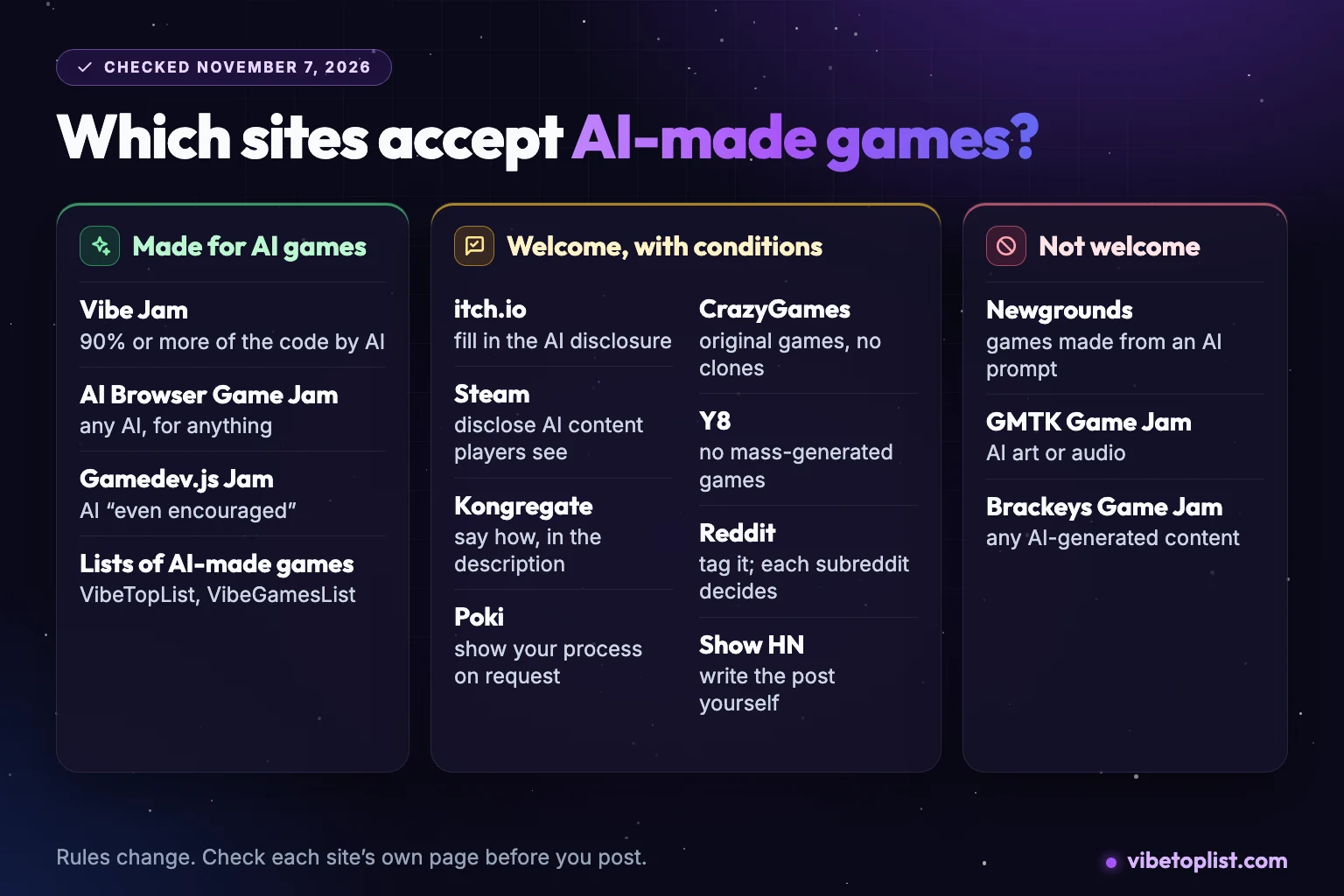
- itch.io asks you to "accurately tag your project if it contains materials produced by generative AI". The form has a box for code, and games that say yes "will appear on the AI Assisted browse page". It also counts "Games or projects that are predominantly created by algorithms or AI with minimal human intervention" as spam (itch.io quality guidelines).
- Steam asks about AI content "that ships with your game, and is consumed by players", such as art, sound and text, and uses your answers to help customers understand what's in the game. About AI tools inside development software, its survey says: "Efficiency gains through the use of these tools is not the focus of this section" (Steamworks).
- Poki: "The golden rule: AI should empower, not shortcut." Be ready "to show how and which tools were used, and to provide an overview of your creation process, prompts, and iterations on request" (Poki).
- Kongregate allows AI tools and asks that "the player-facing game description includes a disclosure that AI has been used, and how it has been used" (Kongregate).
- CrazyGames lists AI tools as one way to build a game, and rejects "Unoriginal content (e.g. clones or asset flips)" (CrazyGames FAQ). Y8 accepts games made with AI tools but "may reject copied, misleading, low-quality, repeatedly reskinned, or mass-generated games" (Y8).
- Newgrounds asks you not to share "any games that were generated via an AI prompt", and to disclose any other AI use in the author commentary (Newgrounds game guidelines).
- Reddit allows AI-made content "subject to each community's specific rules", asks you to "include a tag (or other form of indication)", and doesn't allow AI content that "presents itself as human-generated" (Reddit Help).
The cost of saying so. itch.io players can filter out games that disclose AI, and on November 3, 2026 itch.io said it was adding that filter to more places, "including our search results page" (itch.io on Bluesky). Disclose anyway. The platforms ask for it, players notice, and getting caught later costs more than one honest line. In a GameDiscoverCo survey of about 3,800 core Steam players, published in July 2026, 56% said AI coding tools like Claude Code should be disclosed and only 8% said they shouldn't, while coding was also the use of AI they found most acceptable (GameDiscoverCo).
One line is enough. For example: "Built with Claude Code. I designed the levels and drew the art." Say what the AI did and what you did.
Where to share your game: Reddit, Hacker News and communities
Reddit is where one post can change your week. On October 18, 2026, one thread about VibeTopList in r/aigamedev brought us about 840 visitors, and 70 games were listed that day. But each subreddit has its own rules, and some indie game subreddits don't allow generative AI at all.
- Read the rules first. Reddit's own advice: "Read the rules of a community before making a submission" (Reddiquette). They are in the sidebar, and they change.
- Start where AI-made games are the topic: r/aigamedev, r/vibecoding and the subreddit of the tool you used. Indie game subreddits often ask you to declare AI use, or don't allow it.
- Tell the story, not just the link: what the game is, how you made it, what surprised you, and what feedback you want. In AI subreddits, how you built it is often the most interesting part.
- Don't paste the same post into ten subreddits. "Mass-posting repetitive content for the purpose of exposure or financial gain" is on Reddit's own list of spam (Reddit Help).
- Be a member, not a billboard. "A widely used rule of thumb is the 9:1 ratio, i.e. only 1 out of every 10 of your submissions should be your own content" (Reddiquette).
Show HN on Hacker News
A playable browser game is exactly what Show HN is for: "something you've made that other people can play with" (Show HN guidelines). Three rules matter most:
- "Don't post quickly-generated one-offs; anybody can do that now." Explain how and why you made it.
- Write the post yourself: "Please don't put generated text in HN posts" (HN guidelines).
- Never ask anyone to upvote or comment: "Please don't ask friends to upvote or comment."
Keep your hopes realistic. Of the 382 Show HN posts with "game" in the title from August to October 2026, half got 2 points or fewer and fewer than 1 in 10 reached 10 points (our count, from Hacker News' public search API). A front page can still change everything: after a Show HN reached the front page, the party game platform Gaming Couch had more than 11,000 tracked visitors over one weekend (its developer's write-up).
Your AI tool's community
The people who use the same tool want to see what it can make.
- Cursor's forum: "Sharing what you've built with or for Cursor is welcome", and its Showcase category is the place for it. Write the post yourself: "Posts generated entirely by AI will likely be removed" (Cursor forum guidelines).
- Claude: "Share projects you've built with Claude to be considered for a feature on Claude's social channels or marketing" (Claude community).
- Your engine's forum or Discord, such as Phaser's or three.js', usually has a channel for showing projects.
Discord
Share your game in the channel a server sets aside for it, and nowhere else. Discord's own rules say: "Do not send unsolicited bulk messages (or spam) to others" (Discord guidelines). Once people ask where to follow your updates, start a server of your own and put the invite in the game.
Show the game in a 15-second clip
Short video is now one of the main ways players find games. In GameDiscoverCo's survey of about 10,000 Steam players, it was "a key discovery method for 36% of our respondents", ahead of "Reddit-y discussion forums (29%)" (GameDiscoverCo).
- Open on the best second of gameplay, with no logo intro.
- Film it vertical, 10 to 20 seconds, one idea per clip.
- Post the same clip to TikTok, YouTube Shorts and Instagram Reels, and make many of them: one clip rarely decides anything.
- Plan where the link goes. Links in YouTube Shorts descriptions and comments "are non-clickable" (YouTube Help), so put your game's name on screen and the link in your profile, where people can find it.
- Know the AI labels. YouTube doesn't require a label for "Gameplay footage from video games", but it does for "AI generated music" (YouTube Help). TikTok asks for a label on "realistic-looking scenes or people", and for its content disclosure setting when you are "Promoting your own business, product, or service" (TikTok).
Enter a game jam that welcomes AI
A jam gives your game a deadline, a theme, an audience of other makers and a page people actually browse. Check its AI rule first, because jams differ the most.
- Vibe Jam requires AI: "At least 90% of the code has to be written by AI." Games must be playable on the web "without any login or signup and free-to-play". The 2026 edition had 945 games, and the next one is in April 2027 (Vibe Jam).
- Gamedev.js Jam (April, HTML5): "Use of AI is totally allowed, and even encouraged, as long as you don't break any copyright laws" (Gamedev.js).
- GitHub Game Off runs right now: "You have until December 1, 2026", and "AI-assisted development is allowed" (GitHub).
- AI Browser Game Jam on itch.io lets you use any AI for anything, and it is growing: 321 games in its October 2026 round (itch.io).
- Jams that say no: the GMTK Game Jam disqualifies games with AI-generated art or audio (GMTK), and the Brackeys Game Jam allows "No AI-Generated content" (Brackeys).
Make your game easy to find on Google
The best first week we measured came from people typing a game's name into Google. That only works if your name can be found:
- Use one name everywhere: on your site, on itch.io, in every listing and every post.
- Give your game's page a clear title, like "Name: a tower defence game you can play in your browser", and a few sentences about the game in text, not only in images.
- Link to your game from every listing and post. Each link helps people, and search engines, find your game.
- Listings rank for your name too. Half of the clicks Google sent to VibeTopList between October 8 and November 4, 2026 landed on individual game pages (Google Search Console).
- Add your site to Google Search Console. It is free and shows which searches find your game.
Turn your first players into more players
- Ask for feedback, then act on it. Ask a few specific questions ("Where did you get stuck?"), fix the top three problems, and tell people you fixed them. For a downloadable game, Steam Playtest is "a free, low-risk way to get playtesting data" (Steamworks).
- Post updates, not reposts. A new level, a new mode or a big fix is a reason to post again. A copy of your first post is not. On Show HN, only a big change counts: "A major overhaul is probably ok."
- Measure two numbers: how many visitors start playing, and how long they play. Poki calls 3 minutes of average playtime healthy in its first player test, and CrazyGames says successful games often see 10 minutes or more.
- Give players a reason to come back: saved progress, a daily challenge, a leaderboard, and a link to your Discord or devlog on the end screen.
Your first week, day by day
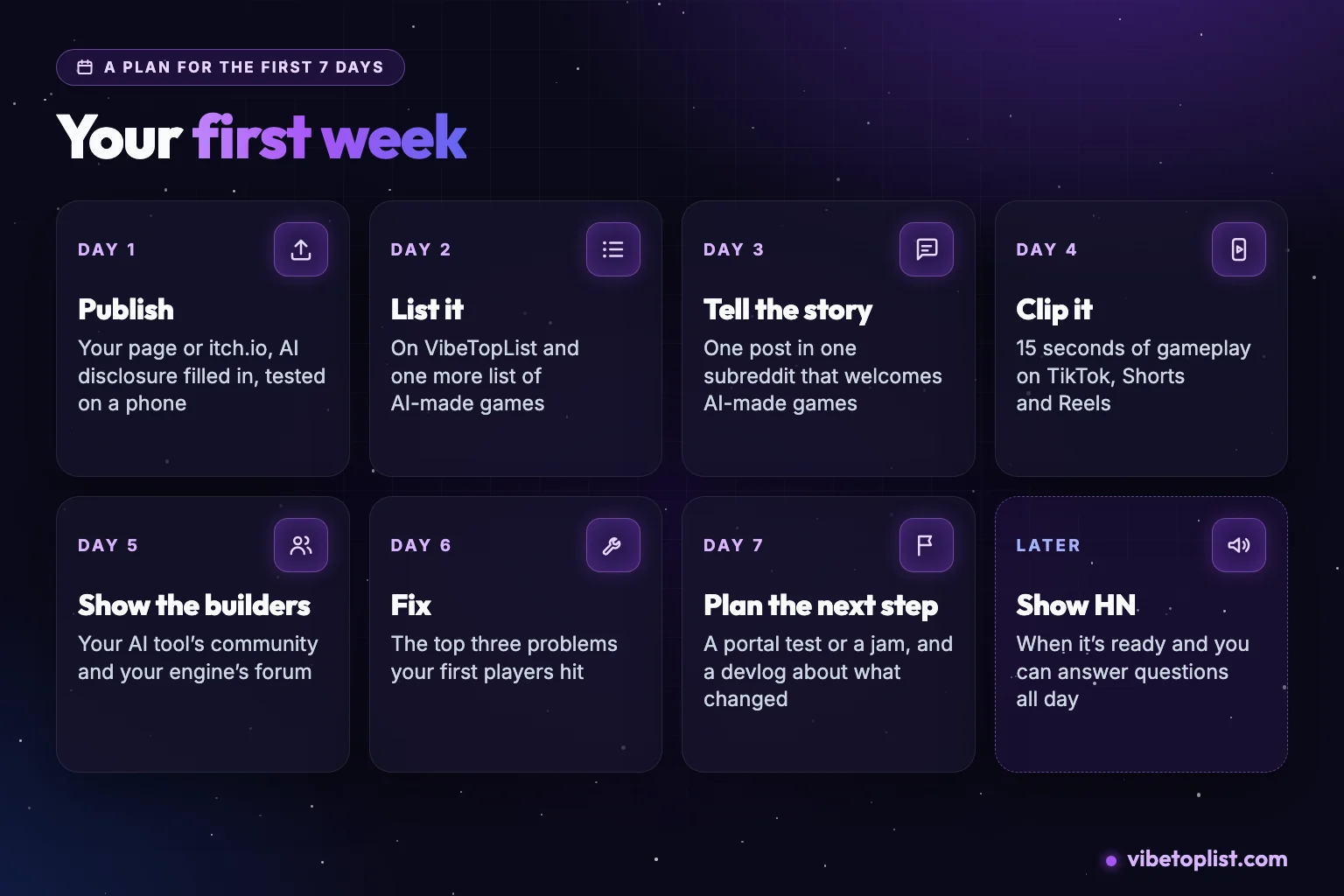
- Day 1, publish: your own page or itch.io, with the AI disclosure filled in, tested on a phone.
- Day 2, list it: on VibeTopList and one more list of AI-made games.
- Day 3, tell the story: one post in one subreddit where AI-made games are welcome.
- Day 4, clip it: a 15-second clip on TikTok, YouTube Shorts and Instagram Reels.
- Day 5, show the builders: your AI tool's community and your engine's forum.
- Day 6, fix: the top three problems your first players hit.
- Day 7, plan the next step: a portal test such as CrazyGames' Basic Launch, or the next jam, and a devlog about what changed.
Keep Show HN for when the game is ready and you have time to answer questions all day.
FAQ
How do I get people to play my game?
Make it playable from one link in the browser, publish it where players already browse (itch.io, a portal, lists of AI-made games), share it in communities that welcome it with a short clip, and keep improving it. On VibeTopList, about 1 in 4 people who open a game's page press Play, so most of the work is getting people to that page.
Where can I publish my game for free?
itch.io, CrazyGames, Poki, Kongregate and Y8 are free to join, and so are lists of AI-made games such as VibeTopList. Steam charges US$100 per game.
Does Steam allow AI-made games?
Yes. Steam asks you to disclose AI content that ships with your game and that players see or hear, such as art, sound and text. Its survey says efficiency gains from AI tools during development are "not the focus" of that section.
Do I have to tag AI-written code on itch.io?
itch.io asks you to tag any project that contains material made with generative AI, and its form has a box for code. Disclosed games appear on its AI Assisted page, and players can filter them out.
Which subreddits can I post my AI-made game in?
Start with communities where AI-made games are the topic, such as r/aigamedev, r/vibecoding and the subreddit of the tool you used. Read each subreddit's rules first: some indie game subreddits don't allow generative AI.
Why does my game get views but no plays?
Usually because the first screen doesn't show a Play button or real gameplay, the game asks for a download or a sign-up, or it doesn't load on a phone. Fix those first.
How many players can I expect in the first week?
From one listing alone, not many: on VibeTopList the typical new game had 11 visitors and one Play in its first week. The games that did far better brought their own visitors, from Reddit, video or people searching for their name.
The short version
Make the game playable from one link. Put it on itch.io, a portal and lists of AI-made games. Say how you used AI. Then share it where people try new games, with a 15-second clip, and keep improving it after the first week. When it is ready, list it free on VibeTopList. For hosting and building, see our practical guide to vibe coding, and to earn from your game, how indie devs make money from vibe-coded games.
How we made this guide: we wrote it with AI assistance, checked every platform rule on the platform's own page on November 7, 2026, and took the player numbers from VibeTopList's own data (October 19 to November 6, 2026; bots, admins and each game's own maker not counted).
Built a vibe-coded game?
List it free on VibeTopList | get a permanent game page, organic traffic, and engaged players who actually vote.
+ Submit Your Game